Minggu, 16 November 2014

Novatek Milestones

Novatek site confirms the internal image sensor design efforts and mentions a number of image sensor accomplishments over 2011-13 years:
  • Oct 2013:
    Introduce Novatek's 1/4" VGA CMOS Sensor with CVBS output
    Introduce Novatek's first 1/7" HD CMOS Sensor with MIPI Interface
  • Sep 2011:
    Introduce Novatek's first HD CMOS sensor
  • Feb 2011:
    Introduce Novatek's first CMOS sensor in 1.75um cell size technology

All these sensors are not mentioned among the current products, and their status is unknown.

Sabtu, 15 November 2014

"Active Pixel Color Sampling" Story Goes On

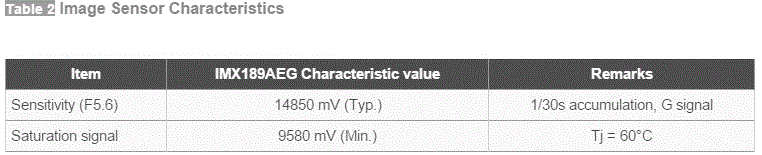
SonyAlpha Rumors publishes more details on the allegedly oncoming Sony IMX189AEG "Active Pixel Color Sampling" sensor. The new material explains how the technology works. The RGB colored microlens layer is not rigidly attached to the sensor surface but rather is able slide along it. Each pixel has one sensing PD and three storage one that store the color info as the microlens layer slides:


A lot of data still looks illogical, such as over 9V saturation level, while the supply voltage is only 4.2V:

Jumat, 14 November 2014

Recent Nikon Patent Applications

Egami blog published a number of recent Nikon patent applications. One of them places small microlenses in corners between the big ones to reduce an optical crosstalk:


Another application, also quoted by New Camera site, proposes an HDR sensor with big and small pixels with big and small Bayer filter patterns:

Himax Reports Q3 Results

Himax reports that its CMOS sensor sales improved significantly in Q3 2014: "Revenues from CMOS image sensors continued to show strength in the third quarter, increasing more than 20% from the previous quarter. Sales of the 2 and 5 megapixel products were particularly strong. However, the Company saw some delays in certain customers’ replacing older generation sensors with lower cost new designs which affected the Company’s gross margin. As expected, 8 megapixel CMOS image sensors began small volume sales in the third quarter and sales will accelerate in Q4 2014. The Company also launched its first 13 megapixel sensor during the fourth quarter. It anticipates 8 megapixel CMOS image sensors to continue to be the mainstream in 2015, and 13 megapixel the rising star in high end smartphones. This puts Himax firmly in the map as one of a handful of companies capable of offering a comprehensive product portfolio for main cameras of smartphones.

Additionally, the Company is also developing CMOS image sensors for non-consumer applications, for example, CMOS image sensor product line for automotive and surveillance applications, which typically enjoy higher margins and have less intensive competition. Collectively, the Company expects its CMOS image sensor business to more than double in 2014, making it a fast rising player in the market.
"

"...the Company continues to partner with various industry leading companies using its cutting edge and industry-dominant wafer level optics, or WLO, for the development of three technologies of the future, namely, array camera, special purpose sensors and microdisplay light guides for head-mounted devices. This product development often requires adoption of Himax’s internal CMOS image sensor, LCOS microdisplay and video processing algorithm teams. Himax sits in a leading and unique position as it is the only company in the industry which is able to offer such a one-stop total solution. To meet the anticipated demand growth for LCOS and WLO products, the Company is working on new plans to expand production capacity. The Company will report the progress in due course."

Kamis, 13 November 2014

Toshiba Enhances Nighttime Performance of its ADAS Processor

Toshiba announces expansion of its line-up of image recognition processors for automotive applications with the launch of the TMPV760 series. Sample shipments of the first device, TMPV7608XBG will start in January 2015, with mass production scheduled for December 2016 onwards.

TMPV7608XBG features includes AEB (Autonomous Emergency Braking), TSR (Traffic Sign Recognition), LDW (Lane Departure Warning) and LKA (Lane Keeping Assist), HBA (High Beam Assistance), FCW (Forward Collision Warning), plus new applications that include TLR (Traffic Light Recognition) and AEB pedestrian (during both day and night), which will become part of the Euro NCAP testing program in 2018.

TMPV7608XBG integrates two Enhanced Co-occurrence Histograms of Oriented Gradients technology (CoHOG) accelerators for far higher accuracy image recognition at night. Connected to multiple, Full HD cameras, the processors analyzes color gradients in supplied images and achieves a night-time detection rate of pedestrians that matches the day-time recognition rate of the company’s current devices. TMPV7608XBG also supports a Structure from Motion (SfM) accelerator that realizes 3D reconstruction using the input stream of a monocular camera, and that can detect motionless obstacles on a road surface that are not detected by conventional pattern recognition.

TMPV760 applications

Update: Nikkei Tech publishes few photos from Toshiba's presentation:

Rabu, 12 November 2014