Kamis, 04 Desember 2014
NIT Announces InGaAs WDR Sensors
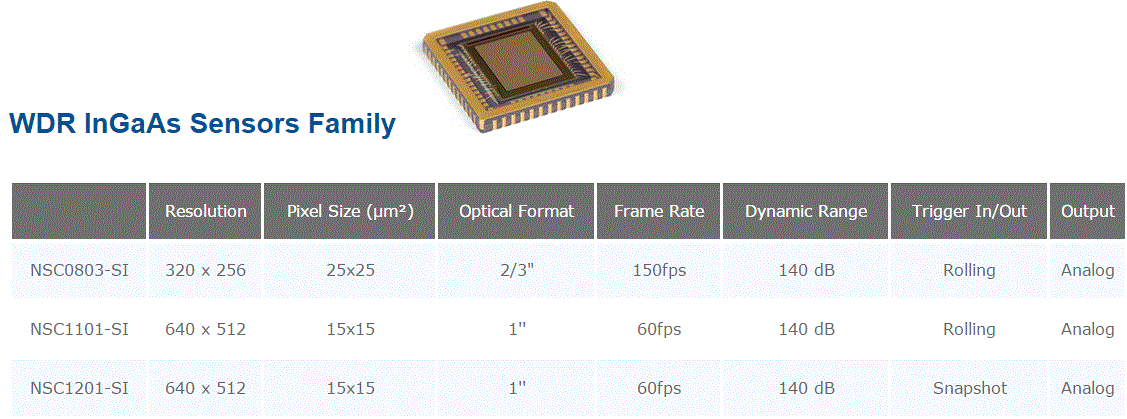
New Imaging Technology introduces the WDR InGaAs products family, including sensors and camera modules. NIT SWIR products are based on a Wide Dynamic Range ROIC and offer DR of more than 140dB in a single image. The internal Fixed Pattern Noise correction gives a high uniformity pictures in all light conditions with no need of Look-up table.

Rabu, 03 Desember 2014
Almalence Announces SuperSensor
Today at the Embedded Vision Alliance meeting, Almalence announces SuperSensor, a technology for mobile camera quality improvement without hardware modifications. “Mobile handset makers always come to a point where camera quality improvement is impossible due to size restrictions or the cost, usually both”, says Eugene Panich, CEO of Almalence. “Using a computational component such as SuperSensor is a way to improve mobile camera features without adding a micron to its size and at just a small fraction of the cost of typical hardware improvement. While hardware improvements can take years to utilize, the time to market for a computational component could be as short as days, and you can even put it into the devices that are already sold via a system upgrade.”
Unlike other imaging solutions, each of which improves some specific property such as dynamic range or noise level only, SuperSensor is said to provide a complex improvement. Its effect is said to be similar to replacing a 1/4” sensor with a 1/3” sensor containing more pixels, which results in higher resolution, lower noise, higher speed, and wider dynamic range altogether:


The full resolution comparison images, pdf presentation, and Android demo application can be downloaded here. The first devices which utilize the Almalence SuperSensor technology are expected to be available on the market in 2015.
Unlike other imaging solutions, each of which improves some specific property such as dynamic range or noise level only, SuperSensor is said to provide a complex improvement. Its effect is said to be similar to replacing a 1/4” sensor with a 1/3” sensor containing more pixels, which results in higher resolution, lower noise, higher speed, and wider dynamic range altogether:
 |
| Top: the font is too small, the illumination is too low and dynamic range is too high to capture the pictures. Bottom: same scenes, same conditions, same camera, but with SuperSensor technology. |
The full resolution comparison images, pdf presentation, and Android demo application can be downloaded here. The first devices which utilize the Almalence SuperSensor technology are expected to be available on the market in 2015.
Omnivision Reports Quarterly Results
PRNewswire: OmniVision's revenues for the quarter that ended on October 31, 2014 were $394.0M, as compared to $406.5M in the previous quarter, and $397.2M a year ago. Based on current trends, the company expects revenues for the next quarter will be in the range of $275M to $305M.
Non-GAAP net income was $36.9M. GAAP gross margin was 22.0%, as compared to 21.7% for the previous quarter, and 18.8% a year ago. The sequential increase gross margin reflected an increase in revenues recorded on the sale of previously written-down inventory and a continued mix shift towards the newer generation products. The Company ended the period with cash, cash equivalents and short-term investments totaling $525.2 million, a slight increase of $1.0 million from the previous quarter.
"Our mobile phone and automotive products continue to be the drivers behind our strong results this quarter," said Shaw Hong, CEO of OmniVision. "We are pleased with our execution in China, and with the emergence of India as a key geography for us. We are also excited about the launch of our high-performance stacked-die PureCel-S products, which demonstrates our technology leadership."
SeekingAlpha publishes Omnivision conference call transcript with more details of the past quarter business.
Non-GAAP net income was $36.9M. GAAP gross margin was 22.0%, as compared to 21.7% for the previous quarter, and 18.8% a year ago. The sequential increase gross margin reflected an increase in revenues recorded on the sale of previously written-down inventory and a continued mix shift towards the newer generation products. The Company ended the period with cash, cash equivalents and short-term investments totaling $525.2 million, a slight increase of $1.0 million from the previous quarter.
"Our mobile phone and automotive products continue to be the drivers behind our strong results this quarter," said Shaw Hong, CEO of OmniVision. "We are pleased with our execution in China, and with the emergence of India as a key geography for us. We are also excited about the launch of our high-performance stacked-die PureCel-S products, which demonstrates our technology leadership."
SeekingAlpha publishes Omnivision conference call transcript with more details of the past quarter business.
Selasa, 02 Desember 2014
Teledyne DALSA on CMOS Sensor Design Challenges
Teledyne DALSA Possibility blog publishes "Keeping up with CMOS Sensor Design" video featuring Matthias Sonder, one of the company's lead designers, talking about the interface speed challenges in his design:
Rambus Lensless Camera Demo
Rambus publishes a Youtube video with Patrick Gill showing the company's lensless camera operation:
Meanwhile, it appears that Rambus somewhat downplays its image sensor activities in its recent investor presentations. For example, in the Nov. 2014 presentation, imaging appears in only one slide #29:

Meanwhile, it appears that Rambus somewhat downplays its image sensor activities in its recent investor presentations. For example, in the Nov. 2014 presentation, imaging appears in only one slide #29:
Senin, 01 Desember 2014
Another Two Video Promotions from Intel
Intel keeps posting promotional videos for its 3D camera-based RealSense technology. The first one shows refocusing capability similar to Pelican Imaging and some Nokia products:
The second video demos 3D scanning:
The second video demos 3D scanning:
Lattice Offers sLVDS to CSI-2 Bridge
Business Wire: Lattice Semiconductor announces its MachXO3 FPGA-based bridge between Sony sub-LVDS CMOS image sensors to the MIPI CSI-2 interface to cost-effectively create camera-based products for mobile, surveillance, machine vision and medical applications. “The sub-LVDS to CSI-2 bridge solution gives designers the freedom to architect their camera based sub-system without compromise,” said Ted Marena, Director of Strategic Marketing, Lattice Semiconductor. “This solution provides flexibility to match the best Sony image sensor with any AP or ISP with minimal additional space, power and cost.”

Langganan:
Postingan (Atom)